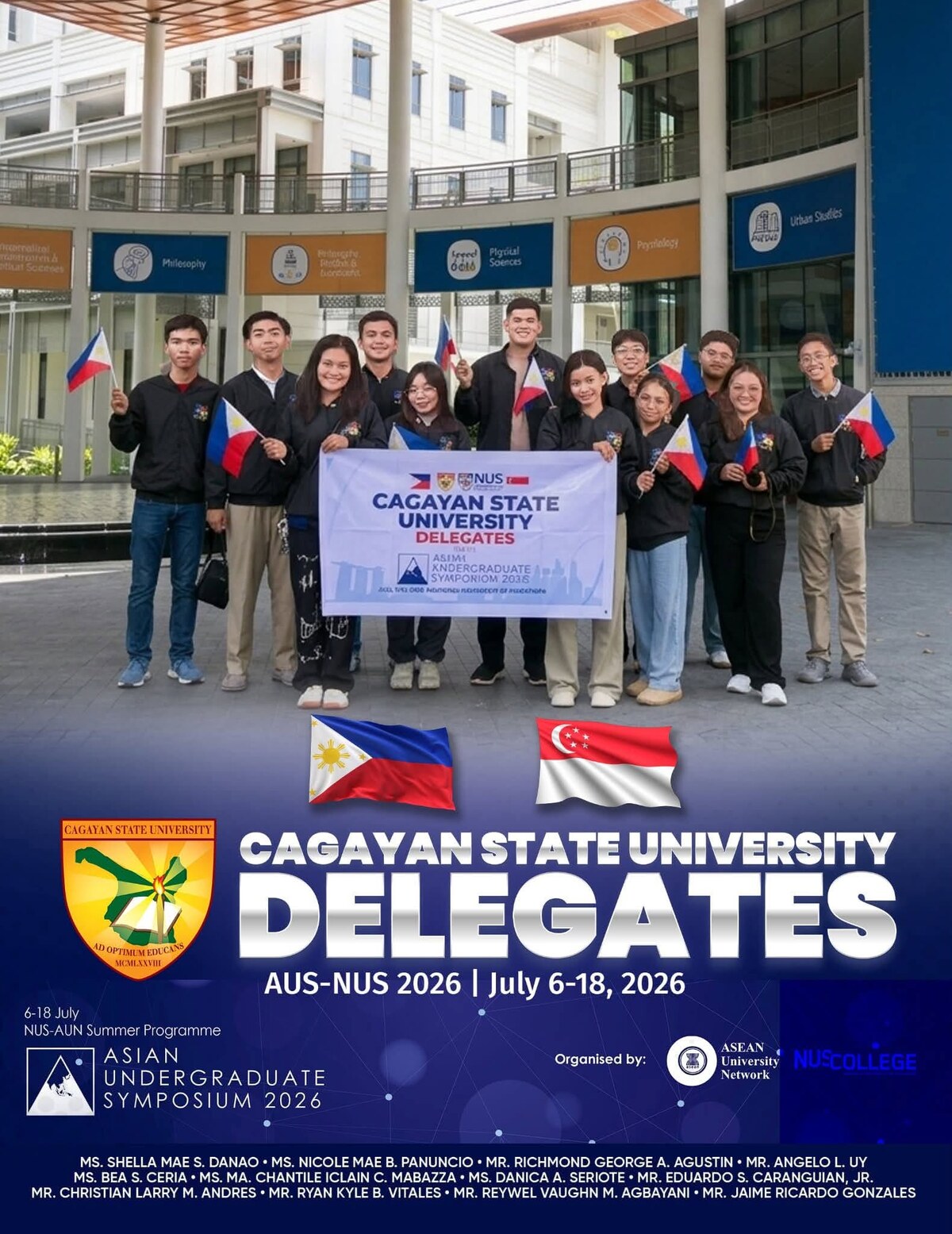
12 Cagayan State University Students Are Representing the Philippines at NUS This Month
They flew in from Tuguegarao for the Asian Undergraduate Symposium, NUS College's flagship two-week programme. Here is what AUS is, why it is a big deal, and who is on the delegation.
Twelve Cagayan State University delegates are representing the Philippines at the NUS Asian Undergraduate Symposium 2026. They are at the National University of Singapore from 6 to 18 July 2026.
The CSU students come from Tuguegarao. They share the delegate roster with the University of the Philippines, De La Salle University, University of Santo Tomas and dozens more universities from 17 countries.
The Cagayan State University delegation to AUS-NUS 2026. Photo: Cagayan State University.
What the Asian Undergraduate Symposium is
The Asian Undergraduate Symposium, or AUS, is a two-week programme run by NUS College, the honours college of NUS.
It began in 2015 under the NUS University Scholars Programme, when around 100 ASEAN undergraduates gathered to work on real community problems in the region.
More than 2,000 young leaders from 90 universities across 17 Asian nations have since gone through it. The programme now anchors the ASEAN University Network's summer camp calendar.
Students meet domain experts, train in project proposal writing and form international teams to design solutions around a shared challenge.
NUS calls the approach the I-4 model: Inspire, Ideate, Intercultural, Implement.
The 2026 theme: Communities in Action
This year's theme is "Communities in Action." It runs across three tracks:
Sustainability and Innovation
Inclusivity and Resilience
Heritage and Culture
Each student picks a problem statement, then builds a project with teammates they met days earlier.
At the close, teams present their proposals in an open session, collect feedback from peers and refine them.
Advertisement
A panel then picks up to ten of the strongest projects. Each gets a seed grant of S$5,000, plus mentorship through an incubation programme.
Last year's cohort produced 40 proposals. One used bokashi balls made from soil and microorganisms to revive biologically dead rivers in the Philippines.
Why this matters to Filipinos in Singapore
Most news about Filipinos abroad covers remittances and sacrifice. This one covers twelve young Filipinos holding their own beside the top undergraduates in Asia.
Some of them may return for graduate study or work. If a younger kapatid is weighing a Philippine state university, this delegate list shows it can reach a regional stage.
The Cagayan State University delegates
Representing CSU at AUS 2026:
Advertisement
Shella Mae S. Danao
Nicole Mae B. Panuncio
Richmond George A. Agustin
Angelo L. Uy
Bea S. Ceria
Ma. Chantile Iclain C. Mabazza
Danica A. Seriote
Eduardo S. Caranguian Jr.
Christian Larry M. Andres
Ryan Kyle B. Vitales
Reywel Vaughn M. Agbayani
Jaime Ricardo Gonzales
You can follow this year's projects through NUS College's Asian Undergraduate Symposium page and its social channels. Congratulations to the delegation and to Cagayan State University.
NUS College Asian Undergraduate Symposium (aus-summer.nus.edu.sg)
NUS News, "Crossing borders, shaping minds," 8 August 2025. Hero and poster: Cagayan State University. Delegation and event details per the official Cagayan State University AUS-NUS 2026 announcement