A little boy in Singapore wouldn’t answer his parents.
They had stuck letter flashcards on his bedroom wall. They pointed. What letter is this? What sound does it make? What number? He stayed quiet.
A few months later, his mother sat down with his Playgroup teacher at 7oaks Preschool in Jurong West and told her what had changed. He was counting everything now. Three bottles on the table: one, two, three. And at home he kept saying the same thing: “Teacher Mae teach me. This A, this B, this C.”
When his mother asked where he learned to count, he gave the same answer. “Teacher Mae teach.”
Teacher Mae told us the story in the middle of an interview, and halfway through she had to stop. “Ayan, pinaiyak niyo naman ako,” she laughed, and reached for her water.
The panganay who taught first
Mae started teaching long before she had a classroom. As the eldest of three, with both parents working, she taught her younger siblings to count and to say their ABCs.
Back in school in the Philippines, she watched her own teacher handle a class of 15 or 20 children and thought it looked impossibly hard. “But when I grew up, I started to have this compassion for children,” she says. “I wanted to be part of their lives.”
She had no plan to work abroad. Then a churchmate who had moved to Singapore ahead of her posted about a teaching job on Facebook. She took her licensure exam before she even had her diploma, applied, and got in.
The first year almost broke her. The food was different. She paid rent on her own for the first time. Colleagues spoke an English she couldn’t always follow, and every “Sorry, can you repeat?” felt to her like a bad first impression. “I mostly cried at night,” she says. “After six months I wanted to go home.”
When her contract ended, she went home for a year. She rested, passed her IELTS, and studied how Singapore preschool teachers work, down to the tricks for holding a toddler’s attention. Then she came back.
The breadwinner who found her way back
Teacher Pat, who teaches Kindergarten 1, took the long way round. She taught at a private school in the Philippines for three years, then left the classroom: as the family breadwinner, she had to find other work. She spent almost three years in shared services and was close to a team leader promotion when a job in Singapore opened.
“During those three years in shared services, I found I missed teaching,” she says. “This is really my calling. It kept hunting me.” In 2024 she took what she calls a leap of faith and applied.
What they bring from home
Ask either teacher what makes her good at this job and she points to how she grew up.
“In the Philippines, our parents teach us to always show care, malasakit, especially to family,” Mae says. “When I came here to Singapore, I see these children and I take them as my own children. So I give my all.”
Parents see it from day one. In January, two new Playgroup parents kept peeking through the classroom window to check if their toddlers were still crying. Mae sends photos home every day in those first weeks: the kids playing, making friends. She asks each family what calms their child, a pillow, some milk, and she bends the schedule when a new child is hungry or tired. “Kahit hindi ako makapagturo, basta safe sila,” she says. Even on a day she can’t teach anything, the children go home safe.
The children answer in their own way. Pat’s students sometimes call her Ibu, the Malay word for mum, then catch themselves: “Sorry, teacher.” When she starts counting “one, two”, they know Ibu has turned back into Teacher Pat.
What surprises Filipino parents
“There’s really a big difference in terms of the school, the children, and how you work,” Pat says. In her first weeks here she watched two-year-olds feed themselves, wash their hands, and sit and listen to their teachers. Back home, she was used to children starting school at five or six. Here, preschool runs a full day, with nap time and outdoor play. For Mae, the difference shows up in the quality of the curriculum.
Discipline follows other rules too. Plenty of us remember a teacher calling us out in front of the whole class. Pat won’t do it. When a child crosses a line, she talks to them in private. “We protect their self-esteem,” she says.
“Hindi lang sila naglalaro”
Advertisement
Then there’s the tita objection: why pay for school if the kids just play? Sayang ang pera. Pat has heard it, and she has an answer.
7oaks Preschool runs an inquiry-based curriculum, which Pat’s class calls IBL. “It allows the children to create their own questions when there are sparks of curiosity,” she explains. The teachers plan the activities around a big question, and the children investigate their way to the answer. “I believe the moment the children ask, it is a learning already, because they want to unlock it.”
For the younger classes, play does the work. “Do you know that play has a big part in child development?” Pat says. “They will explore, they will experiment, they will discover. Socialisation takes place. Ang daming nangyayaring bagay na hindi natin nakikita, kasi ang nakikita lang natin, naglalaro lang siya.”
You can see it in the rooms. The classrooms are mostly wood and neutral tones, which Pat says keeps children calm and focused. In atelier classes, children build open-ended projects from natural materials. And the independence adds up: some of her Kindergarten 1 children still wore diapers in Nursery. Now they pack their own bags, fold their blankets, clear their plates, and race each other to raise their hands.
“Will my child fit in?”
For Filipino families new to Singapore, this is the big one. Pat tells us about a boy who joined in June. It was his first time in any school. In the Philippines he had lived with his lola and did as he pleased. The principal and a senior teacher sat down with his parents to walk them through how the school works. His classmates did the rest, asking the new boy, “Can you hold my hand?” He has settled in now, Pat says. He doesn’t cry, and his parents are glad they enrolled him.
Mae has her own method for shy newcomers. She puts them in a small group with a few classmates and something to build together, and waits for the first conversation. “Hindi instant ’yun,” she says. She repeats it every day until the friendship takes.
What to look for in a preschool
We asked Pat for advice that applies to any school, not only hers. Visit, so you can feel the vibe. Check the curriculum first. Take a centre tour and meet the teachers. Don’t wait for your child to be “ready”, because you can’t tell until they try. And stay involved.
At her centre, parents get a take-home kit each term to work on with their child, and she sends sight-word sentences home so reading practice continues after school. About 70 to 80 percent of parents turn up for school events.
“Wala talagang perpektong school,” she says. Parents and teachers make it work together.
Advertisement
“Don’t be afraid”
We asked Mae what she would say to a Filipino parent standing at the gate with a two-year-old who won’t let go.
“Don’t be afraid to send them here in school, because we as teachers really care for them,” she said. “We will ensure that they are safe here, and that it’s not only about academics. They will learn more about values.” Then she added the part that matters to families far from home: “Let this be a great experience for them, to know more about different cultures.”
Most mornings, she says, the crying in the lobby stops the moment the kids see her face.
Where Mae and Pat teach
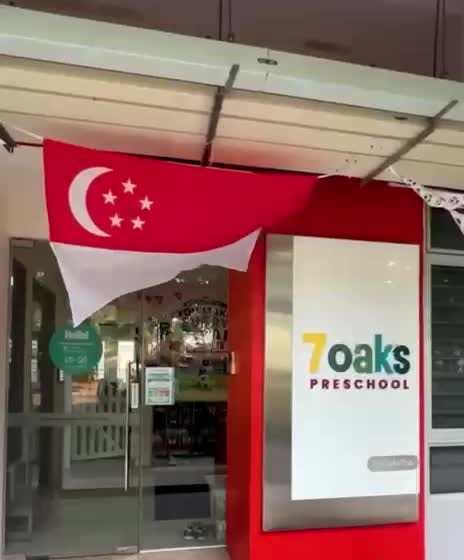
Both teachers work at 7oaks Preschool’s Jurong West Street 81 centre, at Block 826.
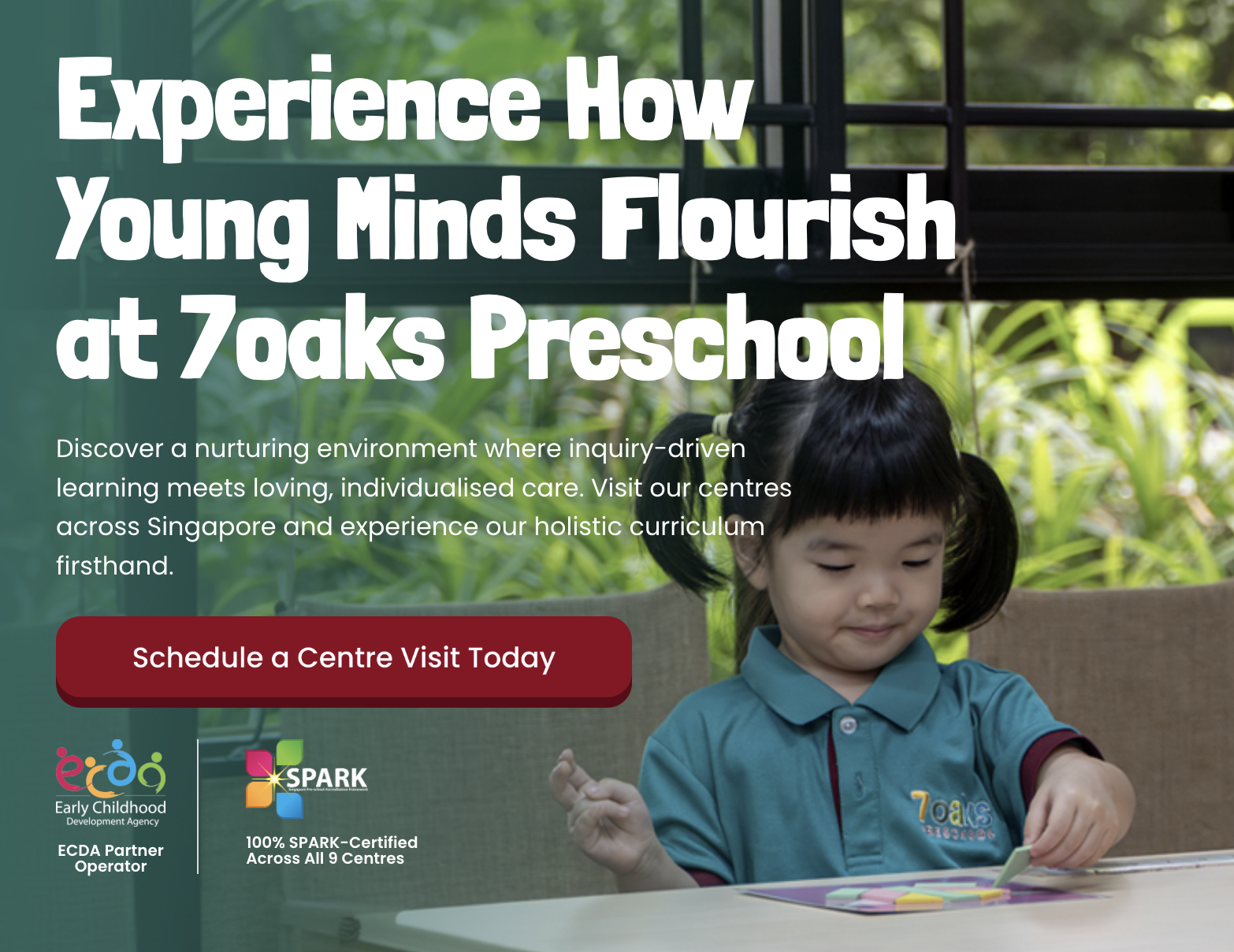
7oaks runs free centre tours there, at Jurong West Street 91 and at 31 International Business Park. Families of non-Singaporean children who enrol at these three centres pay S$350 less each month for the first 12 months. SULIT! members also get the registration, insurance and mattress fees waived, worth S$196.20. The offer runs until 15 December 2026, and you can book a tour on 7oaks’ SULIT! page.