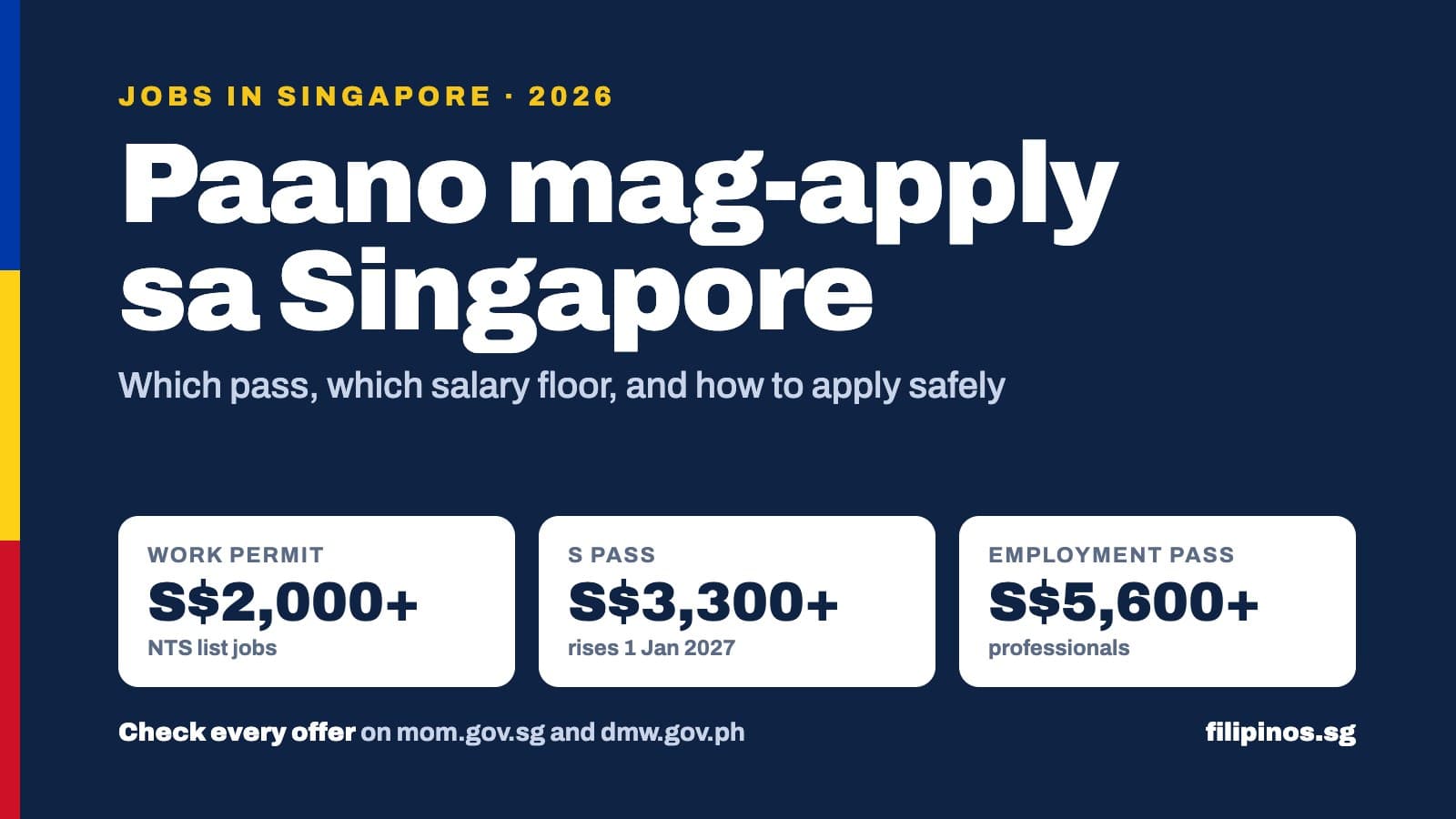
Singapore employers hire Filipinos in 2026 across healthcare, tech, finance, engineering, F&B, hotels, manufacturing, childcare and domestic work, and every one of these jobs needs a work pass that your employer applies for: a Work Permit (S$2,000 minimum for Filipinos outside domestic work), an S Pass from S$3,300, or an Employment Pass from S$5,600. Apply online through MyCareersFuture, JobStreet, LinkedIn, Indeed or a licensed agency, wait for the In-Principle Approval (IPA) letter before you fly, and have DMW record your contract so you travel as a documented OFW.
Kung bago ka pa lang, start with the pass table. It decides whether a job can take you at all.
Which jobs are hiring Filipinos in Singapore in 2026
The roles below come from MOM's own lists: the Shortage Occupation List (SOL) for Employment Pass roles, and the Non-Traditional Source (NTS) Occupation List, which names the Work Permit jobs open to Filipinos. MOM does not publish a count of Filipino hires by sector, so this table carries no ranking. Read it as the map of where the rules let an employer hire you.
Healthcare
Typical roles
Registered and staff nurses, diagnostic radiographers, physiotherapists, occupational therapists
Pass type
S Pass or EP, depending on pay
Salary floor (MOM or DMW)
S Pass from S$3,300; EP from S$5,600. Nurses need Singapore Nursing Board registration for the SOL bonus
Tech and infocomm
Typical roles
Software developers, cloud specialists, data scientists, cybersecurity architects, AI engineers
Infant caregivers, educarers, teacher aides at licensed centres
Work Permit (NTS list)
S$2,000
Transport
Cabin attendants; bus, lorry and trailer drivers with a Class 4 or 5 licence
Work Permit (NTS list)
S$2,000
Domestic work
Household service workers (helpers)
Work Permit for migrant domestic workers
MOM sets no minimum; DMW requires SGD 650 for new contracts from 21 October 2025
Two things to know before you apply. An NTS Work Permit holder may do the occupation printed on the permit and nothing else. And the employer can hold NTS Work Permit staff up to 8% of its workforce, so a small kitchen may have no room even when it likes you.
Which pass you need: Work Permit, S Pass, Employment Pass
Your salary and job title decide the pass. Your employer files it; you cannot apply on your own.
Who it is for
Work Permit
NTS-list jobs and domestic helpers
S Pass
Skilled associate professionals and technicians
Employment Pass
Professionals, managers, executives
Minimum salary now
Work Permit
S$2,000 for NTS jobs; none for helpers
S Pass
S$3,300 (S$3,800 financial services), rising with age
Employment Pass
S$5,600 (S$6,200 financial services), rising with age
New applications from 1 Jan 2027
Work Permit
No change announced
S Pass
S$3,600 (S$4,000)
Employment Pass
S$6,000 (S$6,600)
Other conditions
Work Permit
Age 18 to below 62 at application
S Pass
Employer quota and S$650 monthly levy
Employment Pass
40 points on COMPASS
Family passes
Work Permit
No
S Pass
Dependant's Pass at S$6,000 salary
Employment Pass
Yes, if eligible
Pass length
Work Permit
Up to 2 years
S Pass
Up to 2 years, renewals up to 3
Employment Pass
Up to 2 years, renewals up to 3
Work Permit
S Pass
Employment Pass
Who it is for
NTS-list jobs and domestic helpers
Skilled associate professionals and technicians
Professionals, managers, executives
Minimum salary now
S$2,000 for NTS jobs; none for helpers
S$3,300 (S$3,800 financial services), rising with age
S$5,600 (S$6,200 financial services), rising with age
New applications from 1 Jan 2027
No change announced
S$3,600 (S$4,000)
S$6,000 (S$6,600)
Other conditions
Age 18 to below 62 at application
Employer quota and S$650 monthly levy
40 points on COMPASS
Family passes
No
Dependant's Pass at S$6,000 salary
Yes, if eligible
Pass length
Up to 2 years
Up to 2 years, renewals up to 3
Up to 2 years, renewals up to 3
The floors climb with age. A 35-year-old needs S$4,118 for an S Pass and S$8,382 for an EP today. MOM counts basic pay plus fixed allowances, so overtime, bonuses and commission do not help you clear the bar. For the full age ladder, read our S Pass salary guide.
COMPASS scores EP applications on salary, qualifications, the company's nationality mix and other criteria. Roles on the SOL, such as registered nurse or software developer, earn bonus points.
How to find openings
MyCareersFuture. Before an employer files an EP or S Pass, MOM makes it advertise the job on MyCareersFuture for at least 14 consecutive days and consider every applicant. EP ads must show the salary, and the top of the range cannot exceed twice the bottom. So the board tells you the pay before you apply. For EP roles, companies with fewer than 10 employees and jobs paying S$22,500 or more a month can skip the ad. Check company career pages too.
JobStreet, LinkedIn and Indeed. Set your location to Singapore, not the Philippines. On LinkedIn, write a Singapore-facing headline and list your licences so recruiters find you.
Singapore employment agencies. Search the agency and the agent on MOM's EA Directory at service2.mom.gov.sg. Every registered agent carries a card with a name, registration number and agency; match it against the directory, and look at the "Under revocation / suspension / surveillance" tab for agencies to avoid.
MOM caps what a Singapore agency may collect from you at one month of fixed salary per year of service, up to two months' pay, and your IPA letter shows the amount. Agencies may not charge you for renewals.
Philippine recruitment agencies. Look up the agency on DMW's list at dmw.gov.ph. The list marks each one "Valid License", "Expired" or "Ceased Operations". Then confirm the job order on dmw.gov.ph.
Applying from the Philippines vs already in Singapore
From the Philippines. Philippine law bars a foreign employer from hiring you without DMW authorisation, which MWO Singapore processes (Art. 18, Labor Code). You have two routes:
Agency hire. A DMW-licensed agency handles your papers for a DMW-accredited Singapore employer.
Direct hire with an exemption. MWO can exempt employers hiring for the first time, without DMW accreditation, for up to five professionals or skilled workers. Your IPA must be at least an S Pass. Relatives who are permanent residents can apply too, but not for domestic workers.
Helpers cannot go direct hire. Their papers go through an MWO-accredited Singapore agency. No one may charge a household service worker a placement fee, and no employer may deduct recruitment costs from her salary.
The Philippines runs an employer-pays policy. The employer covers your visa, work permit, round-trip airfare, airport-to-jobsite transport, DMW processing fees and OWWA membership. You pay for your passport, personal documents, clearances, licences, medical exams and Philippine social contributions, and nothing more.
When you leave the Philippines you show an OFW Travel Pass from the eGovPH app, valid 90 days, or an OEC from the DMW e-registration portal, valid 60 days. You show it when you leave the Philippines, not when you come back to Singapore. Keep your OWWA membership active too: SGD 36 for two years at MWO. See our OWWA guide.
Already in Singapore. A new employer files a new pass for you. Once you start, book contract verification at go.mwosingapore.online and pay SGD 15 in cash. You need it if you changed employer, position or jobsite, or if DMW has no record of you. Same employer on renewal? Skip it. Hours and the address sit on our Embassy page.
On a visit pass. You may come for interviews, but MOM requires every foreigner to hold a valid pass before starting work. A visit pass never turns into a work pass. Run the search online and fly in when you have interviews booked.
Advertisement
CV and interview tips for Singapore employers
Two pages, clear titles, numbers. Write "supervised 12 staff" or "cut processing time 30%" instead of a list of duties.
Lead with your licence. PRC, Singapore Nursing Board status, ACCA, CFA, welding certificates. SOL roles reward registration and degrees.
Know your floor before the salary talk. Find your age row in MOM's table. An offer below it cannot get a pass, however good the interview went.
State your status. Write "Based in Manila, available in 30 days" or "Singapore S Pass holder, 1 month notice". Recruiters filter on this.
Prepare for video interviews. Test your camera, mic and lighting. Singapore and Manila share the same time zone, so ask for a morning slot.
Answer the "why Singapore" question with the job. Talk about the work and the team, not the pay gap.
They ask you to pay for the work pass, levy or renewal. MOM makes the employer pay those costs and bars recovering them from you.
No IPA, or an IPA you cannot find. Enter your date of birth and passport number at MOM's Check work pass and application status eService.
The agency is missing from MOM's EA Directory or DMW's list. Walk away.
"Tourist visa muna, aayusin namin ang pass." That is illegal work.
They drop the Embassy's name. The Embassy does not recruit, interview or collect application fees.
A better job in Canada, Poland or Malta, if you pay a visa fee first. The Embassy warns that these recruiters vanish after payment.
Unsure? Call the ScamShield helpline at 1799.
Mabilis na gabay (Tagalog)
Mga trabaho na pwedeng apply-an ng mga Pilipino sa Singapore ngayong 2026:
Alamin ang pass. Work Permit para sa cook, waiter, hotel housekeeping, factory worker, childcare at driver (S$2,000 pataas). S Pass mula S$3,300. Employment Pass mula S$5,600.
Mag-apply online. Gamitin ang MyCareersFuture, JobStreet, LinkedIn at Indeed, o agency na lisensyado ng MOM at DMW.
Ang employer ang mag-a-apply ng pass mo. Huwag lumipad hangga't wala kang IPA letter, at i-check ito sa website ng MOM.
Huwag magbayad para sa work pass o levy. Sagot iyon ng employer. May cap ang agency fee, at walang placement fee ang household service workers.
Ipa-verify ang kontrata. Dumaan sa DMW o sa MWO Singapore para dokumentado ka at may OWWA ka.
FAQ
Can I apply for a Singapore work pass myself?
No. MOM lets the employer or its appointed employment agent apply for a Work Permit, S Pass or Employment Pass. You apply for the job; the employer applies to MOM, and you fly when you hold the In-Principle Approval (IPA) letter.
What is the minimum salary for an S Pass and Employment Pass in 2026?
S$3,300 a month for an S Pass and S$5,600 for an Employment Pass, both rising with age. Financial services need S$3,800 and S$6,200. From 1 January 2027 new applications need S$3,600 and S$6,000.
Advertisement
Can Filipinos get a Work Permit in Singapore?
Yes, for occupations on MOM's NTS Occupation List, such as cooks, waiters, hotel housekeeping, manufacturing workers, childcare workers, cabin attendants and heavy vehicle drivers. The employer must pay at least S$2,000 a month in fixed salary. Domestic helpers use a separate Work Permit for migrant domestic workers.
Pwede bang mag-tourist muna at maghanap ng trabaho sa Singapore?
Pwede kang bumisita at mag-interview, pero bawal kang magtrabaho. Sabi ng MOM, kailangan mo ng valid work pass bago ka magsimula. Ang employer ang mag-a-apply ng pass mo, at hindi nagiging work pass ang visit pass.
How much can a Singapore employment agency charge me?
MOM caps the fee at one month of your fixed monthly salary for each year of service, up to two months' salary. The fee paid to the Singapore agency appears on your IPA letter. Agencies cannot charge you for work pass renewals.
Is direct hiring allowed for Filipinos going to Singapore?
DMW bans direct hiring unless MWO Singapore grants the employer an exemption. Eligible cases include first-time employers hiring up to five professionals or skilled workers on at least an S Pass. Direct hiring of domestic workers stays banned; they go through an accredited agency.
Do I need contract verification if I change employers in Singapore?
Yes. Book contract verification at MWO Singapore on go.mwosingapore.online, bring your signed contract, passport and work pass copies, and pay SGD 15 in cash. You do not need it again if you renew with the same employer.
How do I check if my IPA or job offer is real?
Use MOM's Check work pass and application status eService with your date of birth and passport number or FIN. Check the agency on MOM's EA Directory and on DMW's licensed recruitment agency list. The Philippine Embassy does not recruit or take application fees.
No. MOM lets the employer or its appointed employment agent apply for a Work Permit, S Pass or Employment Pass. You apply for the job; the employer applies to MOM, and you fly when you hold the In-Principle Approval (IPA) letter.
What is the minimum salary for an S Pass and Employment Pass in 2026?+
S$3,300 a month for an S Pass and S$5,600 for an Employment Pass, both rising with age. Financial services need S$3,800 and S$6,200. From 1 January 2027 new applications need S$3,600 and S$6,000.
Can Filipinos get a Work Permit in Singapore?+
Yes, for occupations on MOM's NTS Occupation List, such as cooks, waiters, hotel housekeeping, manufacturing workers, childcare workers, cabin attendants and heavy vehicle drivers. The employer must pay at least S$2,000 a month in fixed salary. Domestic helpers use a separate Work Permit for migrant domestic workers.
Pwede bang mag-tourist muna at maghanap ng trabaho sa Singapore?+
Pwede kang bumisita at mag-interview, pero bawal kang magtrabaho. Sabi ng MOM, kailangan mo ng valid work pass bago ka magsimula. Ang employer ang mag-a-apply ng pass mo, at hindi nagiging work pass ang visit pass.
How much can a Singapore employment agency charge me?+
MOM caps the fee at one month of your fixed monthly salary for each year of service, up to two months' salary. The fee paid to the Singapore agency appears on your IPA letter. Agencies cannot charge you for work pass renewals.
Is direct hiring allowed for Filipinos going to Singapore?+
DMW bans direct hiring unless MWO Singapore grants the employer an exemption. Eligible cases include first-time employers hiring up to five professionals or skilled workers on at least an S Pass. Direct hiring of domestic workers stays banned; they go through an accredited agency.
Do I need contract verification if I change employers in Singapore?+
Yes. Book contract verification at MWO Singapore on go.mwosingapore.online, bring your signed contract, passport and work pass copies, and pay SGD 15 in cash. You do not need it again if you renew with the same employer.
How do I check if my IPA or job offer is real?+
Use MOM's Check work pass and application status eService with your date of birth and passport number or FIN. Check the agency on MOM's EA Directory and on DMW's licensed recruitment agency list. The Philippine Embassy does not recruit or take application fees.